
The original description reports densely silk-lined tunnels or cells beneath rocks and logs in lightly wooded habitats. A thin silk door can conceal the entrance.
Species profile · Helle
Idiothele mira
Blue-foot baboon tarantula
Meet Helle, the Idiothele mira in the Introvertebrates collection. This South African tarantula is known for silk-lined retreats that can close with a delicate trapdoor.
Scientific nameIdiothele mira
FamilyTheraphosidae
Native rangeSouth Africa
TaxonomyAccepted species
SexNot confirmed
In the wild
Natural history.
The blue distal leg segments help distinguish the species. The silk door can be inconspicuous in the field; not seeing one does not establish that a retreat lacks a closure.
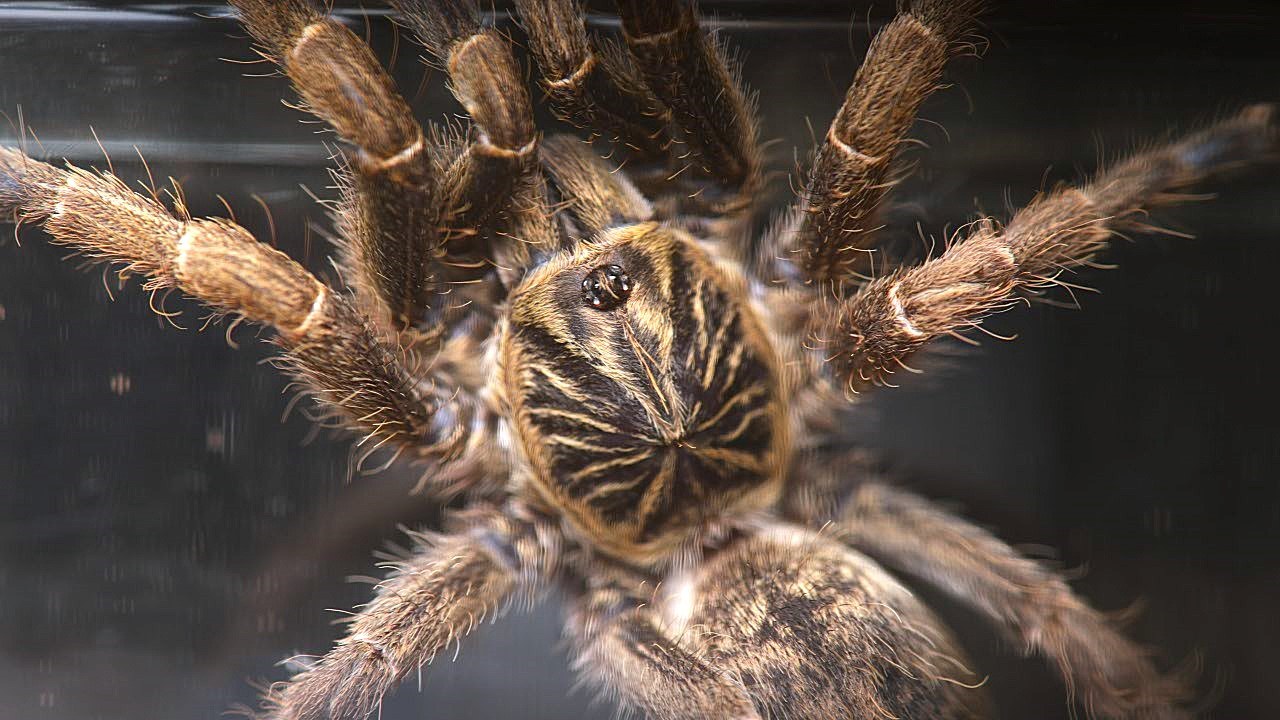
This profile separates the current resident’s documented history from species-level research. The portrait shows Helle.
Taxonomy and range
Idiothele mira Gallon, 2010 is an accepted South African theraphosid. The original description records material from Ndumo and Tembe in northeastern South Africa and distinguishes it from Idiothele nigrofulva.
Burrows, shelter, and activity
Gallon’s field account places retreats under rocks and logs. The entrance can be sealed with a thin, wafer-like silk trapdoor, a useful reminder that elaborate shelter is not restricted to spiders commonly called trapdoor spiders.
Feeding ecology
A concealed retreat is compatible with a predatory lifestyle. Helle’s prey choices and feeding responses belong in the individual collection record; they cannot be inferred from the taxonomic description.
Defence, senses, and movement
The description documents specialised sensory hairs and structures on the limbs and mouthparts. Retreat architecture offers another way to understand the animal without repeatedly opening or disturbing its shelter.
Conservation context
Status, trade & uncertainty.
IUCN evaluates extinction risk; CITES regulates international trade. They answer different questions, and missing data should remain visible.
Assessment not verified
A species-level IUCN category has not been verified for this profile. Lack of a published category here is not evidence of low extinction risk.
Check current listings
Consult the current CITES Checklist and relevant national requirements before any transfer. No legal status is inferred from the presence of the species in captivity.
What the evidence supports
The taxonomic sources establish a name and distribution, not a global population trend. Captive availability cannot substitute for field population data.
Make provenance visible
Keep provenance and acquisition records, and distinguish captive observations from claims about wild abundance.
Taxonomy and linked literature reviewed 18 October 2026. A Red List category and international trade status are not asserted here without a verified assessment or listing.
Life in the collection
Meet Helle.
Helle’s portrait shows the patterned carapace and surrounding legs at close range. It documents Helle as an individual; it does not establish sex, age or the form of the retreat. Those details remain unpublished until verified.
Personal observations
From the Codex.
Introvertebrates Codex
Helle · care history
Time in care, feeding records, moults and measurements. These are observations from the Introvertebrates collection, not species-wide averages.
No public care metrics have been published for this resident yet.
Private notes and identifying details are kept off the website.
Continue exploring
Related profiles.
Read further
Sources.
- World Spider Catalog — Idiothele miraView the source.
- Gallon (2010) — original description and field ecologyView the source.