Posted: 27 November 2026
Source: 17 June 2026
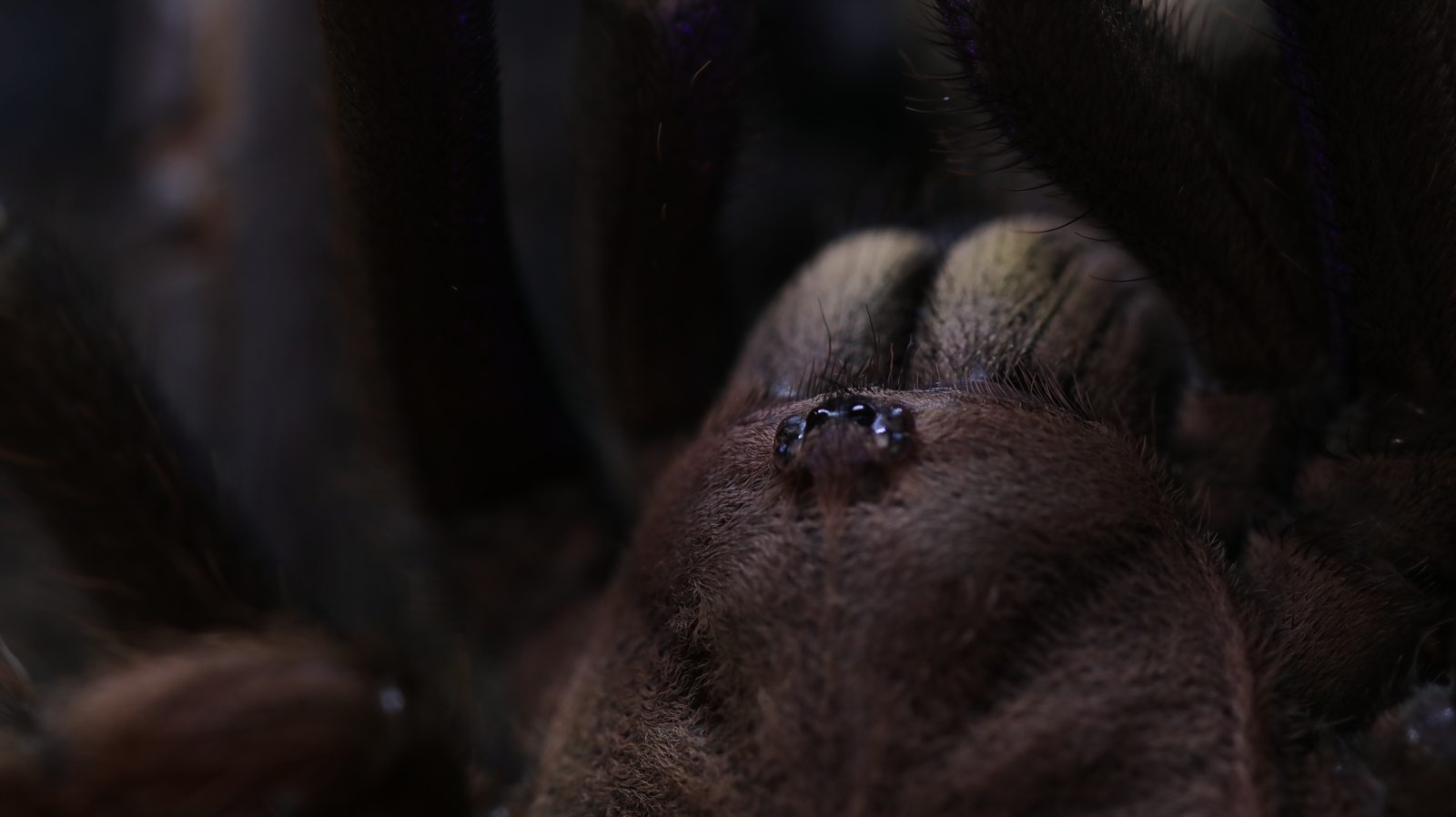
Researchers measured vertical motion at 50 points across a living Grammostola pulchra while brief vibrations passed through an aluminium platform. The distal leg segments tracked the platform closely, while the body and upper legs resonated differently. The authors propose that flexible legs mechanically separate external substrate vibrations from the spider's own body resonance.
Why it matters: Some sensory processing may begin in the spider's physical structure before neurons interpret anything. By damping the body's internal ringing near sensors at the feet, leg biomechanics could improve the signal-to-noise ratio for detecting prey, predators and courtship signals.
Posted: 20 November 2026
Source: 15 November 2026
Researchers mapped 170 occupied Sydney funnel-web burrows and compared their immediate surroundings with nearby control patches. Most entrances were positioned against rocks or trees, while plaster casts showed underground tunnels following the contours of sandstone and roots before widening into one or sometimes two chambers.
Why it matters: A burrow is more than a hole in the ground. For a long-lived, sedentary spider, choosing a solid anchor may shape the shelter, hunting system and microclimate it depends on for years. The study also shows that the famous funnel is only one part of a varied silk structure.
Posted: 6 November 2026
Source: 5 November 2026
Researchers repeated surveys first conducted in 2002 for four short-range endemic Cataxia trapdoor spiders in Western Australia's Stirling Range. Estimated burrow abundance fell by more than 98%, occupied area contracted by 49–67%, and many surviving populations contained few juveniles.
Why it matters: Long-lived trapdoor spiders can remain present as old adults while recruitment quietly collapses. The study shows how fire, drying habitat and isolation can erode ancient mountain populations long before the final spiders disappear.
Posted: 30 October 2026
Source: 21 April 2026
Researchers described Idioctis marevallum, a Mauritian trapdoor spider found in coralline-rock tubes in the intertidal zone. Its silk-lined shelter can be battered by waves or completely submerged at high tide, and its camouflaged door incorporates sand and algae.
Why it matters: The discovery combines an extraordinary habitat with island biodiversity and conservation. The wider survey added 14 spiders to Mauritius's known fauna, increasing the documented total by 27.45%, while the new species is currently known from only two small offshore islands.
Posted: 23 October 2026
Source: 29 October 2020
Experiments on Deinopis spinosa combined neural recordings with behavioural tests. The spiders detected airborne sound from at least two metres away, and low-frequency tones associated with flying insects could trigger a rapid backward strike with their handheld silk net.
Why it matters: Ogre-faced spiders are famous for enormous night-sensitive eyes, but this study revealed a second long-range sensory system. Their legs detect airborne sound, helping them intercept prey outside the visual hunting zone below them—without ears and without hearing exactly as humans do.
Posted: 16 October 2026
Source: 8 August 2022
Researchers filmed 34 young Evarcha arcuata jumping spiders overnight. During otherwise quiet resting periods, the spiderlings showed regular bouts of retinal movement accompanied by limb twitching and leg curling—a combination that suggests an REM sleep-like state.
Why it matters: REM-like behaviour in a tiny, distantly related visual hunter could help researchers investigate how active sleep evolved and what it does. The observations are compelling, but they do not establish that spider sleep is physiologically identical to human REM sleep—or that spiders dream.
Posted: 9 October 2026
Source: 13 May 2019
The triangle-weaver Hyptiotes cavatus tightens its web through repeated movements, stores energy in the silk, and releases it when prey strikes. In a 2019 study, the spider reached peak accelerations of about 79 g; a 2025 follow-up found unusually proline-rich silk proteins that may help explain the web's demanding mechanics.
Why it matters: A spider's web can be an actively powered hunting device. Combining the catapult experiments with later silk research connects behaviour, biomechanics and evolution, while leaving the precise link between silk composition and performance open for testing.
Posted: 2 October 2026
Source: 8 September 2026
Researchers challenged 121 cellar spiders with either one fly or three flies arriving on their webs. When spiders successfully managed several prey, they left the extra flies in place, gathered them together, or bundled two in silk—and did not consistently repeat or improve a solution across trials.
Why it matters: The spiders' flexible responses fit the researchers' predictions for insight more closely than those for an innate or newly learned routine, suggesting that even a small nervous system may solve a familiar problem in more than one way.
Posted: 25 September 2026
Source: 19 September 2026
Researchers collected widow-spider egg sacs from 20 sites across Israel and incubated them until spiderlings or parasitoid wasps emerged. Only one of 1,895 brown widow egg sacs was parasitized, compared with 7.4–23% of egg sacs from three native widow species.
Why it matters: Escaping natural enemies may help the brown widow spread, while releasing these parasitoids as biological control could harm native widows far more than the invader.
Posted: 18 September 2026
Source: 15 September 2026
Researchers trained mated adult female Habronattus pyrrithrix to associate red with bitter prey, then compared foraging where red was informative with trials where colour did not identify palatable prey. Spiders with usable red cues chose edible prey more accurately, ate more of it and laid their first egg sac sooner during the 60-day experiment.
Why it matters: The experiment provides rare direct evidence that colour vision can improve foraging performance and affect the timing of reproduction, connecting sensory ability to a measurable fitness-related outcome.
Posted: 12 September 2026
Source: 5 December 2025
Fertilised Pardosa lugubris females deprived of their egg sacs accepted unrelated sacs in every trial, while females offered their own and a foreign sac chose whichever they encountered first. Offspring removal also altered physiological stress markers.
Why it matters: The study links a remarkable maternal behaviour with measurable physiology, while showing why scientific language such as offspring loss and stress is more accurate than projecting human grief onto spiders.
Posted: 12 September 2026
Source: 3 August 2026
In controlled encounters, tarantulas deliberately directed abdominal urticating setae toward attacking ants. This is the first experimental report of these defensive hairs being actively used against invertebrates rather than vertebrate predators.
Why it matters: The result expands the known function of one of the most distinctive tarantula defences and strengthens the case that interactions with ants may have influenced its evolution.
Posted: 12 September 2026
Source: 17 December 2025
Male scorpions in several groups perform sexual stings during courtship. A new review finds that the behaviour cannot yet be reduced to one explanation, ranging from a coercive knock-out effect to a possible stimulatory love-potion function.
Why it matters: Sexual stinging brings behaviour, venom evolution, and reproductive conflict together—and exposes how much basic scorpion biology remains unresolved.
Posted: 12 September 2026
Source: 6 November 2025
Researchers formally documented spider-shaped web constructions made by Cyclosa longicauda in Peru and a Cyclosa species in the Philippines. Some spiders also shook the web, making the larger decoy move.
Why it matters: The behaviour is an extraordinary example of extended phenotype and possible predator deception, but the defensive advantage still needs direct experimental testing.
Posted: 11 September 2026
Source: 12 August 2026
Researchers crossed Australian redback spiders, Latrodectus hasselti, with their close New Zealand relative Latrodectus katipo and found that the redback male's self-sacrificial mating somersault can reappear in hybrid descendants in a pattern consistent with single-locus X-linked inheritance. A second redback trait, abdominal constriction during mating, showed a more complex genetic pattern.
Why it matters: The study suggests that an extraordinary and apparently complex mating behaviour can evolve through a surprisingly simple genetic mechanism. It also shows that different parts of the redback's self-sacrificial mating strategy can be inherited independently rather than as one tightly linked package.
Posted: 4 September 2026
Source: 31 August 2026
Researchers described Hexura vandal from north-central Idaho. Morphology and genetic evidence distinguish it from the two previously known Hexura species, while surveys suggest a narrow distribution in moist conifer forest.
Why it matters: The discovery expands the known range of Hexura by roughly 500 kilometres and highlights overlooked diversity in isolated forest habitats.
Posted: 28 August 2026
Source: 19 August 2026
Experiments, mechanical tests and simulations involving adult female Argiope trifasciata found that prey impacts produce characteristic pitch-and-roll movements in the spider’s body. The web’s architecture may turn these whole-body motions into clues about impact location.
Why it matters: The result reframes an orb web as more than a passive trap or enlarged vibration sensor. Some useful information may be organized mechanically by the combined spider-web system before the nervous system interprets it.
Posted: 14 August 2026
Source: 25 February 2026
Researchers sampled 245 Oxyopes sertatus lynx spiders at 17 sites in central Taiwan. Genome-wide markers showed declining genetic diversity with increasing urbanization and greater differentiation among urban populations, although analyses did not reveal fully separate genetic clusters.
Why it matters: A species can remain widespread and visibly common while losing genetic variation. The study shows why connected green space matters not only for species counts but also for the gene flow that can help populations respond to change.
Posted: 14 August 2026
Source: 8 April 2026
Researchers assembled a 6.5-billion-base chromosome-level genome for a male Aphonopelma marxi tarantula, then compared it with 20 other spider genomes spanning 15 families. The analysis found that mygalomorph genomes were generally larger and more repeat-rich than those of their araneomorph sister lineage.
Why it matters: This gives the familiar tarantula-versus-araneomorph comparison a genomic dimension. The study does not make one lineage more "advanced" than the other; it shows how two long-lived branches of spider evolution have accumulated very different genomic architectures.
Posted: 14 August 2026
Source: 7 March 2026
Researchers used cryo-focused ion beam milling and cryo-electron tomography to examine natural and artificial silk in three dimensions. In the sampled spider silk, nanofibrils were densely packed, closely aligned with the fibre axis, and separated by very little visible empty space.
Why it matters: Spider silk performance depends on more than its protein recipe. This study directly visualises how nanoscale building blocks are organised, helping connect silk formation with the properties that engineers struggle to reproduce in artificial fibres.
Posted: 14 August 2026
Source: 13 December 2025
Researchers analysed 16S rRNA data from 1,090 spiders across 34 families in southwestern China. Wandering and ambush hunters had higher gut-microbe diversity than web-builders, while geography and endosymbiont infections also contributed to the patterns.
Why it matters: Spiders are not isolated predators; they also host microbial communities. The unusually broad sampling shows that hunting strategy and place can be associated with those communities, while the authors caution that much of the assembly pattern was stochastic and geographically limited.
Posted: 14 August 2026
Source: 18 November 2025
A 67-amino-acid secretory peptide called SpiCE-DS8 was found in the dragline-silk system of sampled Nephilinae spiders. In wet-spinning experiments, adding its conserved core increased beta-sheet ordering and improved several mechanical properties of silkworm and spidroin-containing fibres.
Why it matters: Spider silk performance depends on more than the large spidroin proteins usually highlighted. This study suggests that a small, recently evolved helper peptide can influence protein assembly and fibre mechanics, offering another clue for synthetic-silk design.
Posted: 12 August 2026
Source: 2 July 2026
A broad comparative study found that spiders relying more heavily on vision while hunting repeatedly evolved more forward-facing eye arrangements, while the different eye pairs can shift somewhat independently over evolutionary time.
Why it matters: Spider eyes are not just a fixed eight-eye blueprint. Their arrangement carries information about how different lineages interact with the world, and it shows how behaviour can repeatedly shape sensory anatomy.
Posted: 12 August 2026
Source: 15 June 2026
Researchers combined published observations, field and laboratory records, and iNaturalist photographs to more than double the number of harvestman species with documented parental-care data in the superfamily Gonyleptoidea.
Why it matters: The study shows both how varied arachnid parental behaviour can be and how carefully verified public observations can answer evolutionary questions that would be extremely difficult to sample through fieldwork alone.
Posted: 25 April 2026
Source: 15 April 2026
Researchers measured heart-rate changes in Jorō spiders and golden silk spiders exposed to traffic noise. Responses differed between species and were mild compared with severe stress, pointing to both a detectable physiological effect and considerable resilience.
Why it matters: The study shows why simply finding an animal in a noisy urban habitat does not reveal the whole story, while avoiding the equally misleading claim that traffic leaves these spiders overwhelmed.
Posted: 25 April 2026
Source: 12 April 2026
A 2026 study in the Journal of Morphology tested whether detailed body measurements could reliably separate Lasiocyano sazimai from closely related Lasiodora species. Despite extensive morphometric analysis, the authors found broad overlap, high within-species variation, and poor cross-validated separation, showing that morphology alone has clear limits in this lineage.
Why it matters: This matters because it shows that even detailed measurements are not always enough to separate closely related tarantulas. In morphologically conservative groups, taxonomy may need multiple lines of evidence instead of relying on shape alone.
Posted: 21 April 2026
Source: 18 February 2026
Researchers described Pikelinia floydmuraria from Tolima, Colombia. The study documents both sexes and records a varied diet in human-built environments, including prey much larger than the spider.
Why it matters: The species shows that overlooked diversity and useful ecological observations can be found in walls and other ordinary human-shaped habitats, not only remote wilderness.
Posted: 21 April 2026
Source: 18 March 2026
Researchers described Balticolasma wunderlichi from a male in Baltic amber and a likely conspecific female in Rovno amber. The fossils are roughly 34–38 million years old and provide the first fossil record of Ortholasmatinae.
Why it matters: The fossils add a missing piece to harvestman evolutionary history and show that a lineage now absent from Europe lived there during the Eocene.
Posted: 18 April 2026
Source: 30 March 2026
Nine field observations of arboreal and fossorial tarantulas describe repeated visits to productive locations and rapid, directed returns to retreats. The patterns are consistent with experience-based spatial orientation, but controlled experiments are still needed.
Why it matters: The observations challenge the idea that tarantula movement is entirely rigid or reflexive, while showing exactly where intriguing natural history ends and stronger evidence must begin.
Posted: 18 April 2026
Source: 10 April 2026
Researchers described Mogrus shushka and Mogrus pune from western India, recorded Mogrus larisae in India for the first time, and formally described the male of Mogrus rajasthanensis.
Why it matters: The study adds two species while also improving identification and distribution knowledge for the genus across semi-arid and human-altered habitats.
Posted:
Source:
Why it matters: